Does the side match?
The diagnosis says right knee and the injection note says left. One of them is wrong, and the payer will find it.
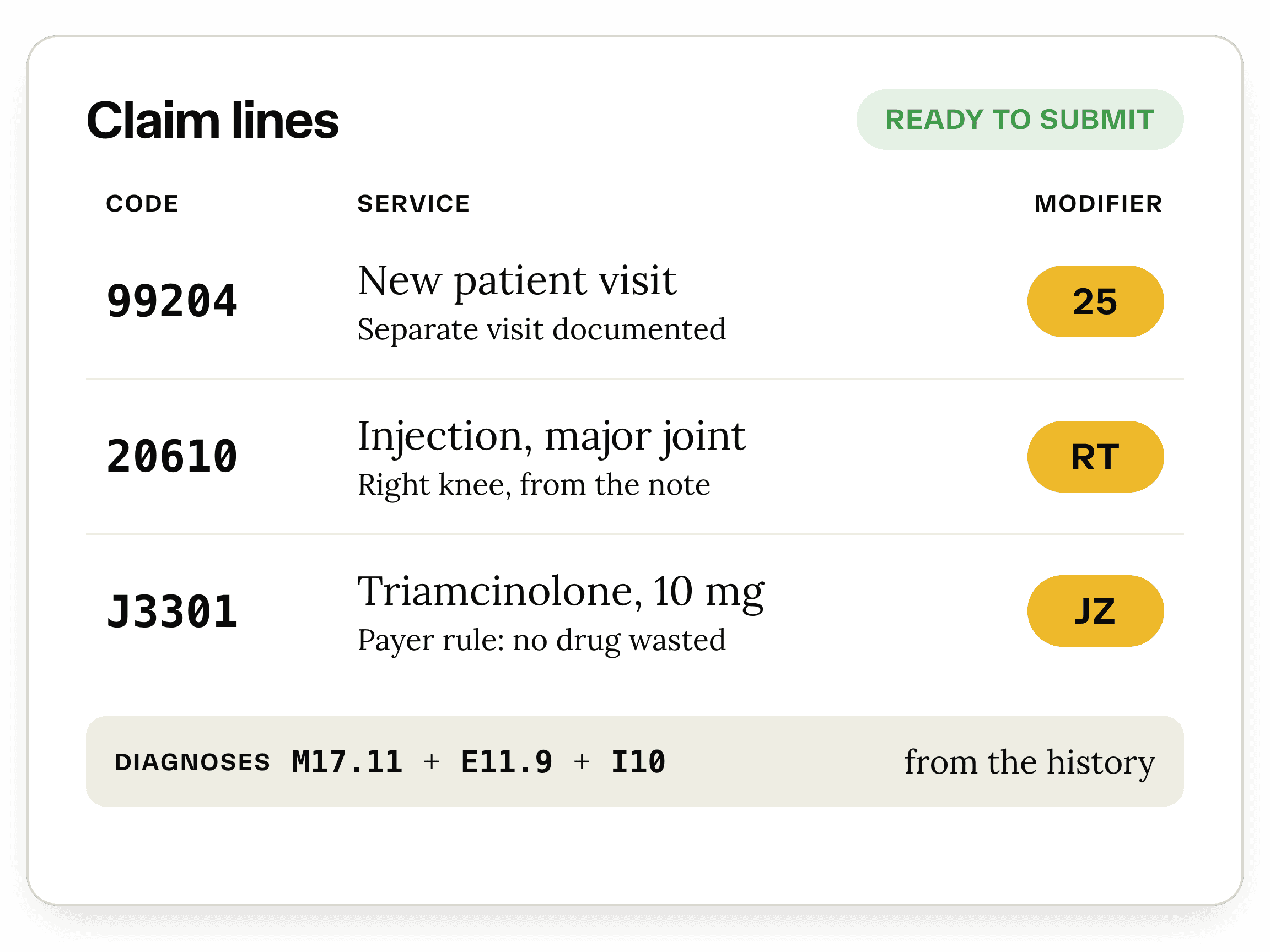
Your scribes code the visit. A Clicks agent reads every note before the nightly batch, fixes the modifiers, side, and pointers your billers would catch, and holds anything unclear with a note.
The agent reads the progress note, adds modifier 25 and the side, confirms new patient status, carries over comorbidities, sets the referring provider, and marks the claim ready to submit.
Illustrative recreation using fictional patient data.
Scribes pick the codes during the visit. Before anything goes out, a biller reopens the note and checks it line by line. The work is not hard. It is the volume: every visit, every provider, every night.
The diagnosis says right knee and the injection note says left. One of them is wrong, and the payer will find it.
A visit and a procedure on the same day need modifier 25 when the visit is separately documented. Without it, the visit goes unpaid.
New patient codes only hold if the group has not seen the patient in three years. Someone has to check the visit history.
Diabetes, hypertension, and other chronic conditions sit in the past medical history. Scribes rarely carry them onto the claim.
Some payers want the JZ modifier on drug codes, and managed care plans want the PCP as referring provider. Those rules live in billers' heads and on sticky notes.
During the pilot your billers keep checking every encounter. We compare the agent's coding with theirs and report how often they match, so you decide on results from your own visits.
No. Scribes still code during the visit and billers keep the final say. The agent does the second look before the claim goes out and hands your billers only the visits that need a decision.
eClinicalWorks, athenahealth, ModMed, Epic, NextGen Healthcare, and any other system your team can log into. The agent works the same screens your billers use, so there is no integration project or data migration.
During the pilot your billers check every encounter the agent reviewed. We report how often the agent's coding matched theirs and go through every mismatch with you, so you see accuracy on your own visits before anything runs on its own.
The agent holds the claim, writes a billing note that says what it found, and adds a tip for the scribe. It does not guess. Your billers decide, and the claim moves on.
Yes. Every held claim comes with a short note on what was missing from the documentation, such as the side of an injection or the X-ray findings, which you can pass on to the scribe.
No risk, no commitment. We prove value before you pay.