
Denial appeals
92% of appeals won at 1/4 the cost
Appeal packages drafted the moment the denial arrives
Read the case studyClicks works with an orthopedics group in New Jersey to automate the state's Attending Provider Treatment Plan form for imaging such as MRI, CT, X-ray, and EMG, plus DME and injections. Every Personal Injury Protection treatment waits on a complete APTP, so nothing is authorized until the submission package is out the door.

Preparing an APTP form by hand
15 min per form
of admin time
3 FTE
on forms
Preparing it with a Clicks AI agent
0 min per form
of staff time
0 FTE
on forms
None of the form is hard. Every part of it lives somewhere in the EHR, which is why one submission used to walk a coordinator through the chart, the orders, the credential file, and the payer record before it was ready for signature. The agent reads each block from its source, infers the few fields that have to be worked out, and leaves only the signature.
Patient, policy, and accident details
From the EHR patient info window and Notes
Provider credentials
From the practice's own records
Diagnosis and ICD-10 codes
Read from the provider's own documentation: the scripts, the referral, or the locked note. Never added.
Care path
Inferred from the diagnosis and the request
Treatment rows
CPT inferred for imaging orders, HCPCS and injection codes read from the request, duration and dates from fixed rules
Attestation and signature
Left for the provider, who reviews and signs.
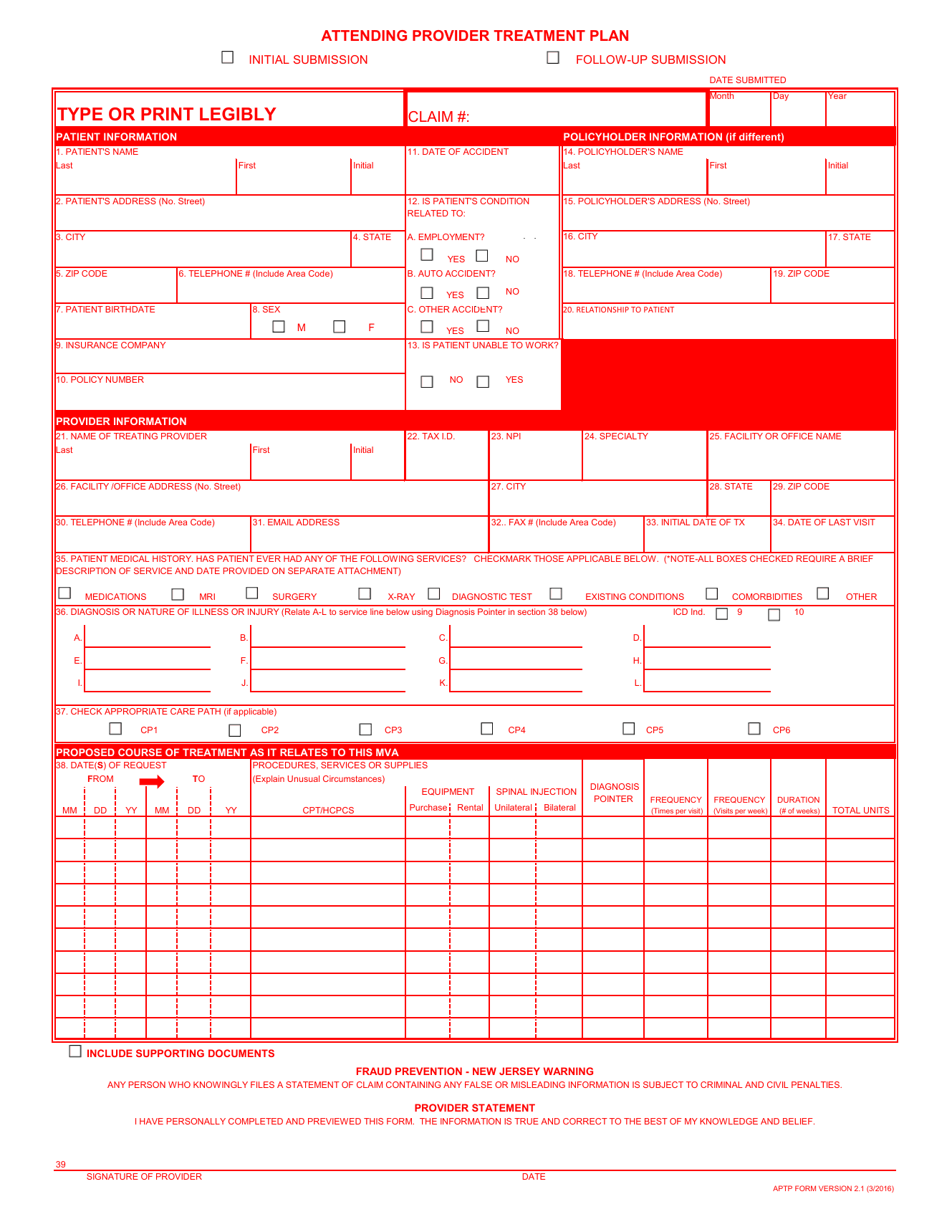
New Jersey APTP form, version 2.1. Highlighted blocks are the ones the agent prepares.
When a required field is empty, or the orders and the note disagree, the agent stops and sends the case back to the team with that specific field called out. When the note is not locked in time, it reassigns the item to the coordinator. That is the difference between a form that is prepared and a form that has to be checked twice.
The form is only part of the deliverable. The agent reads the patient record, the orders, and the locked note, fills the APTP, and assembles the submission: the form, the order scripts, the locked progress note, and the post-accident imaging, PT, and chiro records capped at 30 pages. It infers six fields. Everything else is read from the EHR as written.
Patient record
Info window and patient Notes
Orders and notes
Scripts, referral, locked note
Patient Docs
Imaging, PT, and chiro records

AI agent infers
APTP package
Uploaded to APTP drafts and assigned to the coordinator
The agent gathers patient information and supporting documentation from the EHR and creates the entire APTP submission, ready for the provider to review and sign.
eClinicalWorks demo using fictional patient data in a test environment.
Preparing an APTP form used to take a coordinator about 15 minutes of hunting through the chart and retyping, and across thousands of forms a month that work occupied three full-time staff. Preparation time is now zero for the team, because the agent assembles the whole submission and the provider picks it up at review and signature. Submissions that arrive complete the first time have cut denials caused by admin mistakes by 24 percent.
Zero admin time
Down from about 15 minutes per form
3 FTE to zero
Staff who used to prepare forms full time
24% fewer admin denials
Submissions arrive complete the first time
The Attending Provider Treatment Plan, or APTP, is the form New Jersey requires before treatment is authorized on a Personal Injury Protection case. It collects patient and accident details, policyholder and insurer information, provider credentials, diagnosis codes, and the requested treatment, and it has to be signed by the attending provider.
Imaging such as MRI, CT, X-ray, and EMG, plus durable medical equipment and injections. For each request the agent fills the APTP form and builds the full submission package around it.
Yes. A Clicks AI agent reads the required fields from the EHR, meaning the patient info window, the patient Notes, the order scripts, the referral, and the locked encounter note, fills the APTP form in the structure the payer expects, assembles the supporting records, and routes exceptions back to the team. The provider reviews and signs the completed form.
From the provider's own documentation. The agent reads the ICD-10 codes off the order scripts, the referral, or the Assessment section of the locked note. It never adds a diagnosis code of its own.
The agent works out six things: the auto insurer and claim, whether a pre-cert waiver applies, the CPT code for imaging orders, the body region and its evidence, the care path and its dates, and the units and bilateral flag. Every other field is read from the EHR as written, and the agent flags anything it cannot find.
The orthopedics group in this story went from roughly 15 minutes of administrative time per APTP form to none, because the agent prepares the whole submission before it reaches the provider. That work used to occupy three full-time staff. The group prepares thousands of APTP forms a month this way.
No. The agent leaves the attestation and signature block for the attending provider. The provider reviews the prepared form, including the diagnosis codes read from their own documentation, and signs it. The agent never decides medical necessity.
The thinking behind these engagements, written up in full.




No risk, no commitment. We prove value before you pay.